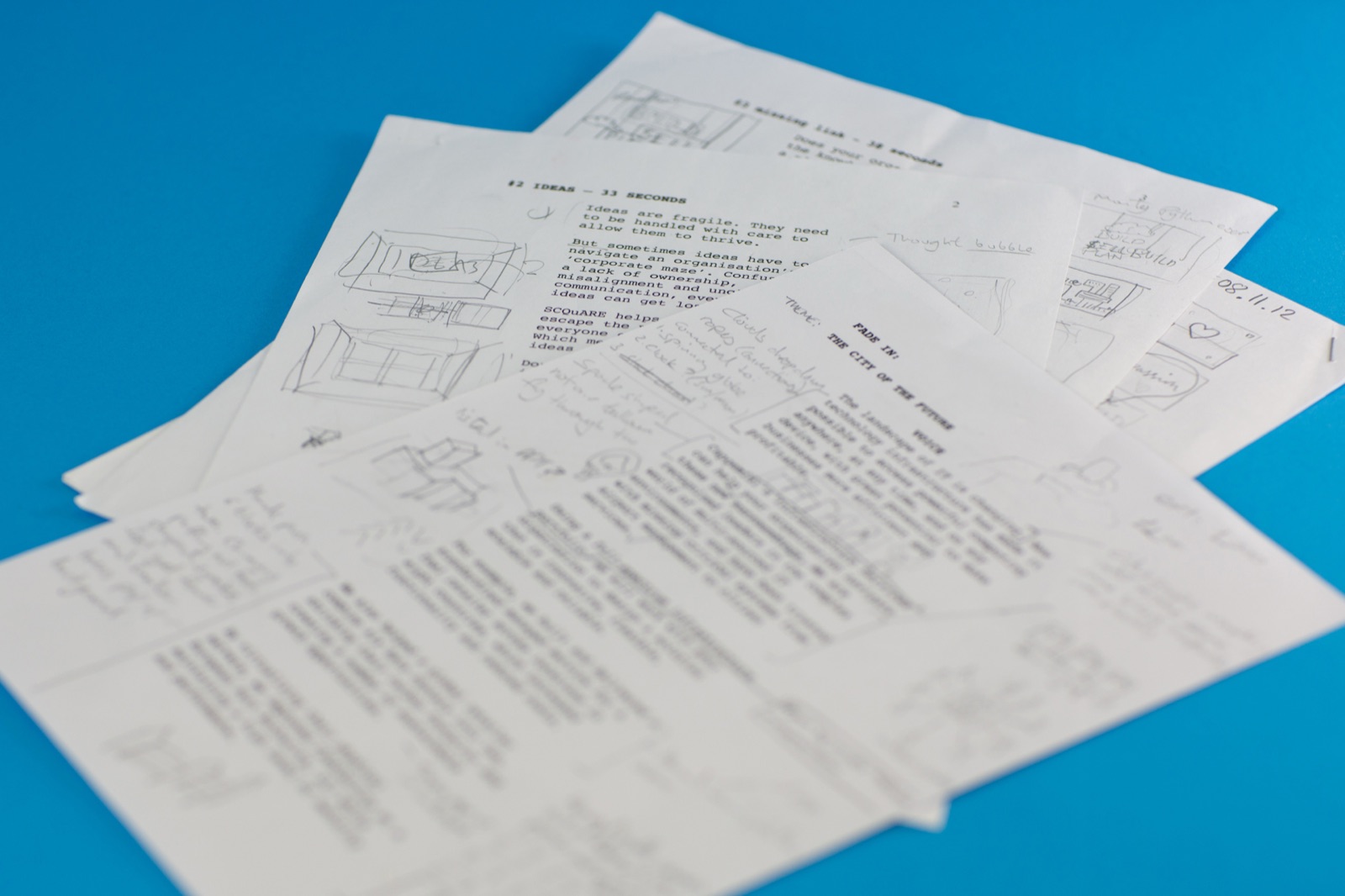
A good explainer video starts with a good script. Not a deck, not a treatment, not a list of features — a script. The words that will be spoken over the visuals. Everything else builds from there.
We’ve written and produced enough explainer films to know where scripts go wrong. Most of the time, it’s not the writing. It’s the brief behind the writing. Here’s how to get it right before you commission a single frame of animation.
Find the one thing
Every stakeholder wants their message in the film. Legal wants the disclaimer. Product wants the feature list. Marketing wants the tagline. The result is a script that says everything and communicates nothing.
Before you write a word, answer one question: if the viewer remembers only one thing, what should it be? Not two things. Not three. One. Everything else in the script exists to support that single message.
This is harder than it sounds. It requires saying no to good ideas because they dilute the great one. But a focused script at 60 seconds will outperform a cluttered one at three minutes, every time.
Write for the ear, not the eye
An explainer script isn’t a blog post. It isn’t a whitepaper. It will be read aloud by a voice artist and heard once, at speed, while the viewer is also processing visuals. That changes everything about how you write.
Short sentences. Plain language. No jargon unless your audience genuinely uses it daily. If a word has a simpler synonym, use the simpler one. Read your script out loud — if you stumble over a phrase, the voice artist will too, and the viewer definitely will.
Grammar matters more than you’d think. A misplaced comma changes emphasis. An ambiguous “it” sends the listener back three sentences to figure out what you meant. By then, the film has moved on without them.
Tell a story, not a list
Features are not a story. Benefits are not a story. A story has a beginning, a middle, and an end. It has a character with a problem, and a resolution that makes their life better.
The character is your viewer — the person watching this film because they have a need. The resolution is what your product or service does for them. The middle is where you earn their trust by showing you understand their problem before you solve it.
This is where StoryBrand thinking earns its keep. The brand isn’t the hero. The customer is. The brand is the guide — the one with the plan and the credibility to help.
Keep it short
Here’s a rough word-count guide for scripted voiceover:
- 30 seconds: ~60 words
- 60 seconds: ~130 words
- 90 seconds: ~195 words
- 120 seconds: ~260 words
Those numbers assume a natural reading pace. If your 60-second script runs to 200 words, it will either be rushed or it will run long. Neither is good.
And remember: every second of animation costs money to produce. A line that says the same thing twice isn’t just redundant — it’s doubling the production cost of that idea. Be ruthless with repetition.
Don’t direct the visuals
It’s tempting to write stage directions into the script. “Camera pulls back to reveal…” or “We see a montage of…” Resist this. Your animation team will interpret the script visually, and they’ll almost certainly find solutions you wouldn’t have thought of.
Write the words. Trust the craft. If there’s a specific visual that’s essential to the message — a product demo, a data point, a brand moment — flag it in the brief, not the script. Keep the script clean for the voice artist. The same brief should also state which aspect ratios you need to deliver — that decision shapes blocking, framing, and edit pace, and it’s much cheaper to know upfront.
Iterate, then iterate again
First drafts are starting points. The seventh version of a script is almost always better than the first. Read it aloud. Share it with someone who hasn’t been in the briefing meetings. If they don’t understand the message in one pass, the script isn’t ready.
The time you invest in the script saves multiples in production. A script change at draft stage costs nothing. A script change at animation stage costs real money and real time. Get the words right first.