You’re building a budget for a stop-motion project. The brief is approved, the concept is exciting, and someone needs a number. The honest answer is: it depends. But that’s not useful, so here’s what it actually depends on.
This isn’t a rate card. Every project is different, and publishing fixed prices would either undersell the craft or scare off work that’s perfectly achievable. What we can do is walk through the variables that move the number — so you can make informed decisions about where to invest and where to economise.
The variables that shape a stop-motion budget
Stop-motion costs are driven by a handful of interconnected decisions. Change one, and the others shift with it.
The type of stop motion
Stop motion isn’t one technique — it’s a family of them, and the approach shapes the budget significantly.
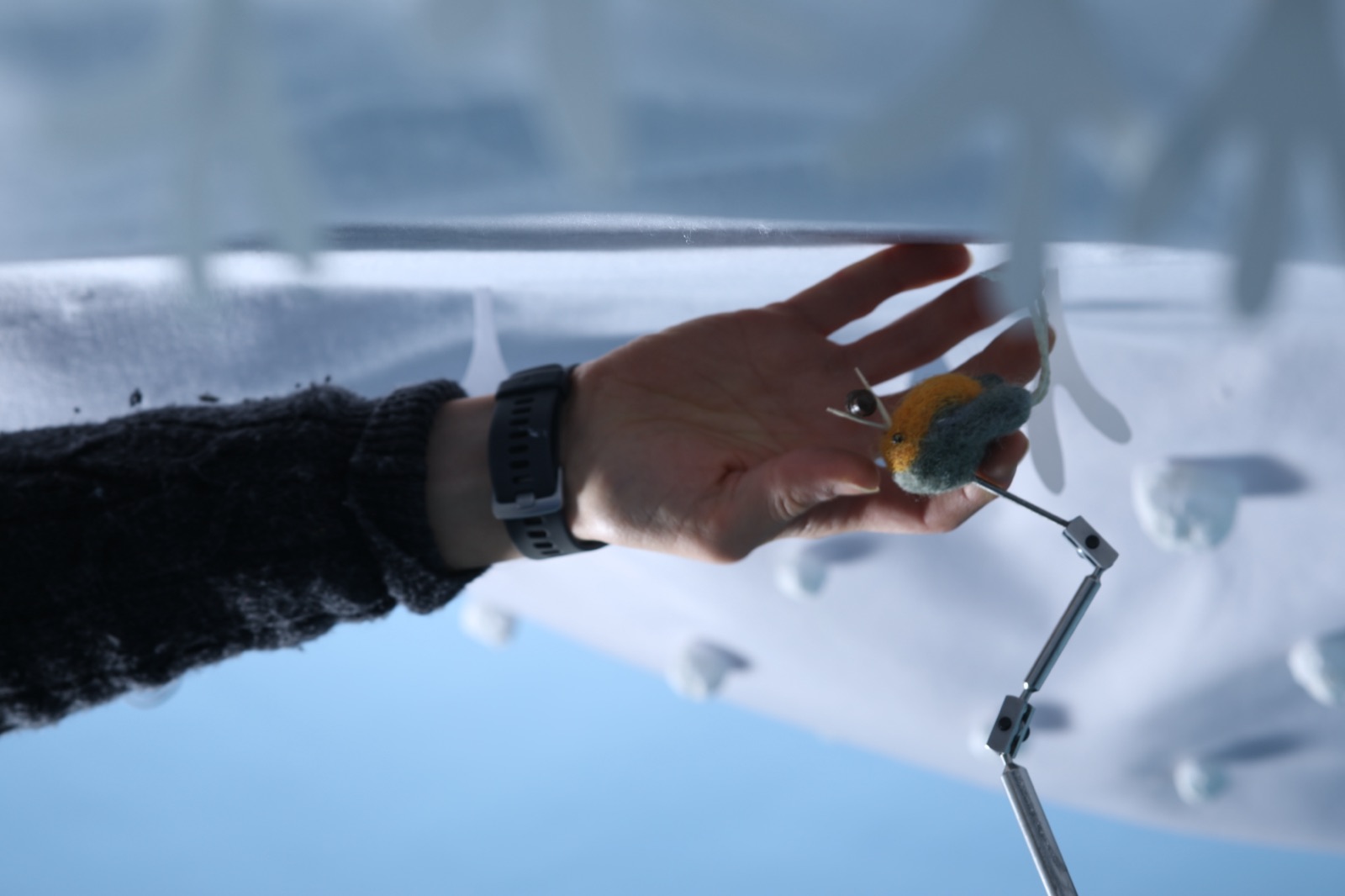
Character animation uses purpose-built puppets with internal armatures, replacement mouths or faces, and often interchangeable hands. A simple felt figure with basic arm movement is a different proposition from a fully rigged puppet with moving eyes and dozens of expressions. Build time alone can range from days to weeks per character. If the brief calls for multiple hero characters, each with a full range of actions and emotions, that’s a significant portion of the budget before a single frame is shot.
Product and tabletop animation works with real objects — packaging, food, cosmetics, toys — animated directly on a styled surface. There are no puppets to build, but the precision required is high. Products need to look flawless in every frame, which means careful rigging, consistent lighting, and often duplicate products to swap in when surfaces show wear. The set-up is meticulous, but the build costs are lower than character work.
Paper craft and cutout animation uses flat or semi-dimensional paper elements — illustrated characters, layered environments, folded shapes. The charm is in the graphic quality and visible materiality. Build costs sit between tabletop and full character work, depending on how many elements need to be constructed and how they articulate.
Pixilation uses real people as the “puppets,” shot frame by frame. There are no build costs for characters, but the shoot itself is physically demanding and technically precise. It requires patient performers, careful choreography, and often more takes than you’d expect. Depending on the brief, you may also need wardrobe and even a manicurist — when real hands and bodies are your on-screen talent, every visible detail matters. The budget trades build time for shoot time.
The question to ask early: what technique does this story actually call for? A product launch might need tabletop. A brand film might call for characters. A social campaign might work beautifully as paper craft. The right technique for the brief is also usually the most efficient one.
Number of sets and environments
Every set is designed, built, lit, and dressed. A single tabletop environment is straightforward. A narrative that moves through three distinct locations — a kitchen, a street, a workshop — means three sets, each with their own props, surfaces, and lighting setups.
Sets can be reused and redressed. A clever art department can make one set serve multiple story beats with different lighting and props. That’s worth discussing at concept stage, not in post.
Animation complexity
This is where the frame count matters. Stop motion is shot one frame at a time — typically 12 or 24 frames per second, depending on the style. Smooth, fluid movement at 24fps takes roughly twice as long to shoot as stylised animation at 12fps. Both look intentional. The choice is creative, not a compromise.
Beyond frame rate, the complexity of the action drives the schedule. A product sliding across a surface is simpler than a character running across a room and jumping onto a sofa. Multiple elements interacting in the same shot — characters with props, products assembling themselves, paper layers folding and unfolding — multiply the time again. Every element that moves in frame needs an animator’s attention for every single frame.
Shoot days
This follows directly from everything above. More sets, more complex animation, more techniques in play — more shoot days. A contained 15-second tabletop spot might shoot in two to three days. A 60-second narrative with character animation and multiple setups could need two weeks or more on the stage.
What’s often overlooked: the stage days start before the animation does. There’s typically a build day to get sets constructed and dressed, followed by a pre-light day where the DP and gaffer dial in the lighting for each setup. These aren’t optional extras — they’re what makes the animation days productive. If you skip them, you spend expensive animation time fiddling with lights.
A typical stage day runs 8am to 7pm with an hour for lunch. Overtime happens, but a well-planned schedule avoids it. That’s a 10-hour working day for a specialist crew — and why even a “short” shoot adds up quickly.
One of the most effective ways to get more from your stage time is shooting on multiple stages simultaneously. You’re already paying for the studio, the DP, the gaffer, and the core crew — adding a second stage means adding another animator, but the overhead stays largely the same. We often shoot on two stages for this reason. It’s one of the best economies of scale available in stop motion.
Shoot days are the most visible cost in a stop-motion budget. They bundle together the stage hire, crew, equipment, and the animator’s time. When you’re looking for ways to manage the budget, this is usually where the maths lives.
Crew
Stop motion looks intimate on screen — small characters, tiny sets, delicate movements. The crew behind it is not small. Even a modest production typically needs 10 to 15 people. A larger project can easily involve 20 or more.
A typical stop-motion crew includes: a director, one or more animators, a director of photography, a model maker or puppet fabricator, a set designer and builder, a props maker, a rigger (who builds the supports that hold everything in place during the shot), a lighting technician, a compositing artist, and a production manager keeping the whole thing on schedule.
For product and tabletop work, you might swap the puppet fabricator for a food stylist or product handler, but you still need the core animation, camera, and lighting team. Paper craft adds specialist makers. For pixilation, the director and animator take on the choreography directly — there’s no separate movement director; the people who understand frame-by-frame timing are the ones guiding the performers.
The point for producers: stop motion is not a one-person-with-a-camera operation. The crew is lean compared to live action, but it’s a genuine production team — skilled specialists, each responsible for a part of the craft that shows on screen. Crew costs are a real line item, and understanding who’s needed (and why) is part of scoping the project honestly.
Art direction
This is the line item that catches people off guard. Puppets, sets, and props aren’t off-the-shelf — they’re designed and built to brief. A hero puppet with a full armature, multiple expressions, and spare parts is a significant investment. A detailed set with practical lighting, textured surfaces, and dressed props is another. Even product and tabletop work needs considered art direction — the styling, surfaces, and background elements all need to be sourced or made.
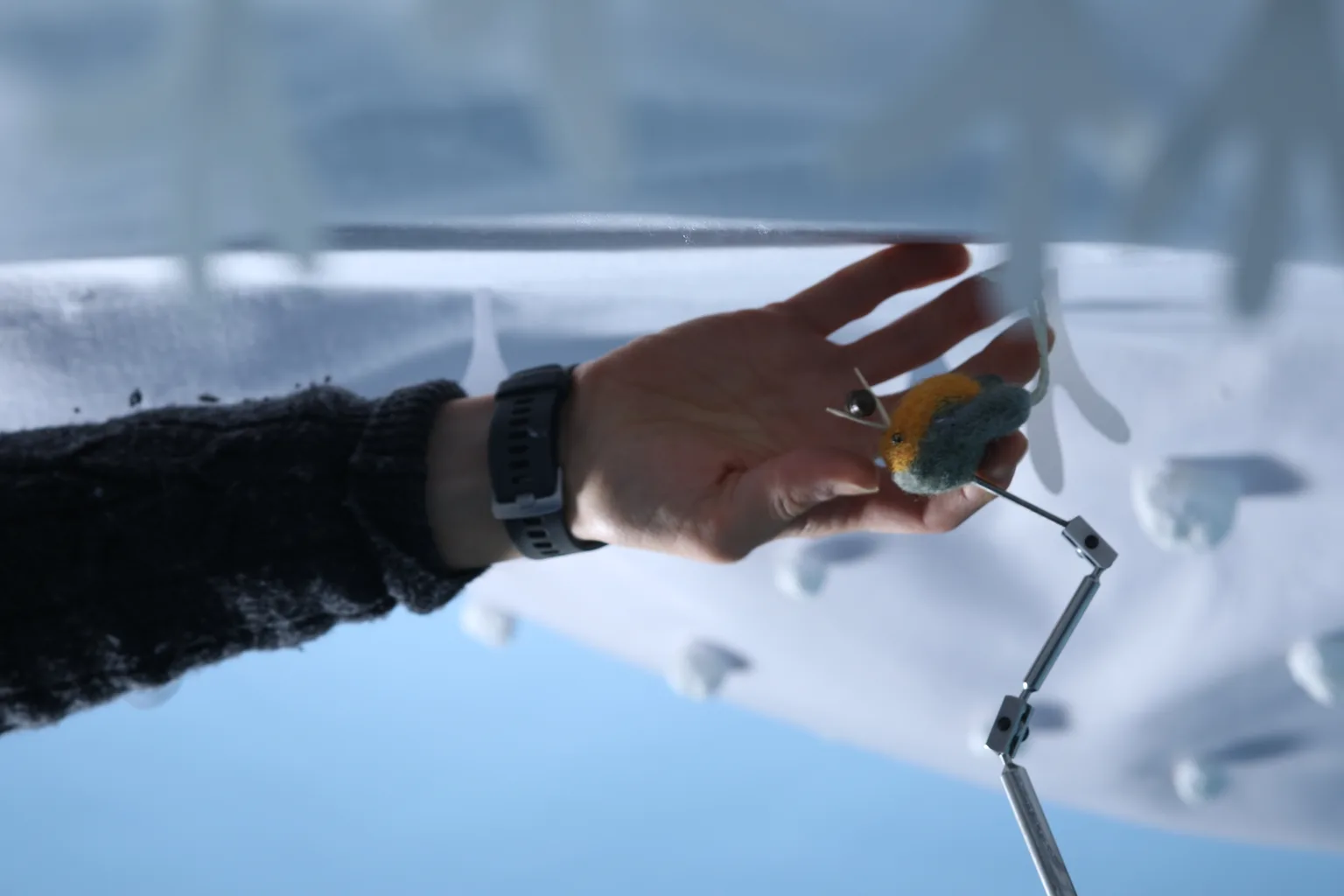
The cost scales with the ambition. A simple graphic setup with a clean surface and minimal props is a different proposition from a fully realised miniature world. Both are valid — the brief should drive the call.
One thing worth noting: shoot in a studio wherever possible. Location shoots add transport, weather risk, unpredictable lighting, and a long list of logistical complications that inflate the budget without improving the work. A good set builder can create almost any environment on the stage, with the advantage of total control over every element in frame.
Post-production
The footage comes off the stage as thousands of individual frames. From there, it needs compositing, colour grading, rig removal (the supports that hold everything in place during the shoot), and often visual effects work — adding backgrounds, enhancing lighting, or combining elements shot separately.
Sound design, music, and voiceover sit alongside this. A well-designed soundscape does enormous work in stop motion — it sells the physicality, gives weight to the materials, and makes the world feel real.
Post-production on a stop-motion project is rarely a quick assembly edit. Budget for it accordingly.
What drives the cost down
Not every project needs the maximum of everything. Here’s where experienced producers find efficiency without sacrificing quality.
Efficient planning
The single biggest cost saver in stop motion is thorough pre-production. Animatics, storyboards, and shot lists that are locked before the shoot starts mean less wasted time on the stage. Stage time is expensive. Planning time is not — at least, not comparably. The same logic applies to the script itself — every line you tighten before production is a line you don’t pay to reshoot.
When we see budgets blow out, it’s almost always because the concept wasn’t locked before the cameras started rolling. A change to the script on shoot day doesn’t just cost the reshoot — it costs the set redress, the lighting reset, and the schedule compression that follows.
Reusing assets
Characters and sets can carry across multiple films. If the brief includes a series — three spots, a social campaign, a seasonal refresh — building assets once and reusing them across deliverables dramatically changes the per-unit cost. The upfront investment is higher, but the cost per film drops with every subsequent use. The same applies to delivering a single shoot in multiple aspect ratios — the second and third ratios cost a fraction of the first if the project is planned that way from the start.
This is worth raising in the first conversation. A project scoped as a one-off will be quoted differently from a project scoped as the first in a series.
Simpler setups
Not every shot needs a full environment. Product animation on a seamless background, a single light source, paper cutouts on a clean graphic surface — these are legitimate creative choices that also happen to be more efficient to produce. Some of the most memorable stop-motion work is beautifully simple.
The question isn’t “how do we make this cheaper?” It’s “what does this story actually need?” Sometimes the answer is a product on a styled surface, beautifully lit, doing one thing perfectly. Or a paper character moving through a flat graphic world. The technique and the ambition should match.
Shorter durations
A 15-second spot costs less than a 60-second film. That’s obvious. What’s less obvious is that shorter durations force creative discipline. The brief gets sharper. The animation gets more purposeful. Every frame earns its place. Some of the strongest work in stop motion is under 30 seconds.
The timeline question
Rushing a stop-motion project costs more than giving it the time it needs. Always.
When the schedule compresses, you either add crew to run parallel setups (more expensive) or you cut corners on the animation (worse outcome). Neither is ideal. The most cost-effective stop-motion projects are the ones where the timeline was realistic from the start.
A rough planning guide: allow two to four weeks for pre-production (asset builds, set construction, animatic), one to three weeks on the stage, and two to four weeks for post-production. These ranges vary enormously depending on scope and technique — a tabletop product spot sits at the short end, a character-driven narrative at the long end, with paper craft and pixilation falling somewhere in between depending on complexity.
If the deadline is genuinely immovable, have that conversation early. It’s almost always possible to adjust the scope to fit the time. It’s much harder to adjust the time to fit an ambitious scope.
What you get for the investment
Stop motion has a quality that’s difficult to replicate digitally. The imperfections are the point — the slight wobble, the texture of real materials, the way light falls on an actual surface. Audiences notice this, even if they can’t articulate why. It reads as craftsmanship. It reads as care.
The tangibility matters commercially, too. Stop-motion content consistently outperforms on engagement metrics — people stop scrolling because something looks and feels different from everything else in their feed. In an environment saturated with motion graphics and AI-generated imagery, physical craft stands out more than ever.
The assets have a long shelf life. Characters and sets exist as physical objects that can be photographed, exhibited, used in PR, and brought to events. The production itself generates behind-the-scenes content that performs well on social. You’re not just buying a film — you’re buying a world that continues to work for the brand after the edit is delivered.
The question nobody asks
What does cheap stop motion cost you?
Below a certain budget threshold, the craft starts to suffer in ways that are visible on screen. Characters move less fluidly. Sets look thin. Lighting is flat. The charm that makes stop motion worth doing in the first place starts to disappear — and what’s left looks like a compromise rather than a choice.
The risk isn’t just a worse film. It’s a film that undermines the reason you chose stop motion. If the budget doesn’t support the technique, it’s worth having an honest conversation about whether a different approach serves the brief better. A well-executed motion graphics piece will always outperform a poorly executed stop-motion one.
The studios that do this well will tell you that upfront. It’s not a sales tactic — it’s a respect for the craft and for your budget. The right partner will help you find the version of the project that’s excellent at whatever the budget allows, rather than spreading a tight budget across an ambitious scope and delivering something mediocre.
How to think about your budget
If you’re putting together a budget for the first time, here’s a practical framework:
- Start with the story. What needs to happen on screen? What technique does it call for — character animation, product tabletop, paper craft, pixilation? How many environments, how much movement?
- Understand the crew. Stop motion requires a specialist team. Even a straightforward production needs 10+ people. Factor that in early — it’s not a line item you can quietly halve.
- Budget the art direction honestly. Puppets, sets, and props are bespoke. This is often where the gap between expectation and reality is widest. Get a clear picture of what needs to be built before the shoot is scheduled.
- Define the deliverables. One hero film? A series? Social cutdowns? Each additional output adds cost, but less than the first — especially if planned from the start.
- Set the timeline. Be honest about it. A realistic schedule is one of the best budget-management tools available.
- Talk to a studio early. Before the budget is locked, not after. A good production partner can help you scope the project to fit reality — adjusting complexity, suggesting the right technique, finding the version that works.
- Protect post-production. It’s tempting to allocate the bulk of the budget to the shoot and squeeze post. Don’t. The edit, compositing, and sound design are where everything comes together.
The best stop-motion projects we’ve been part of started with an open conversation about budget. Not a number thrown over the wall — a discussion about what’s possible, what’s essential, and where the craft can do its best work within the constraints.
That conversation is free. And it’s always the right place to start.